Payday Loan Scams in Canada: How to Spot Them
The red flags of fake lenders, upfront-fee scams and fake debt collectors, how to check a licence in your province, and what to do if you’ve been targeted.
The most common payday loan scam in Canada is simple: a website or text offers guaranteed approval, then asks you to pay a fee, “insurance” or a “first payment” by e-Transfer, gift card or crypto before the money arrives. The money never comes. A licensed payday lender doesn’t work that way: in provinces with payday loan laws, lenders can’t take their fee out of your advance or collect it before the loan is due, and they must show a provincial licence. If you’ve already paid, stop sending money and report it to the Canadian Anti-Fraud Centre at 1-888-495-8501 and your local police.
- Never pay to get a loan
- Check the provincial licence
- Report to the CAFC

Payday loan scams: the short answer
- If anyone asks you to pay before you receive a loan, it’s almost certainly a scam. FCNB lists upfront payments, guaranteed approval, instant approval and unusual payment methods as the main warning signs.
- Every payday lender, online or in a store, must be licensed in your province. Check the licence on the regulator’s website or by phone before you share personal information.
- Some sites pose as lenders but are lead generators that sell your information. Ontario warns this can put you at risk of identity theft.
- Fake debt collectors also target past payday loan borrowers with threats of arrest or wage garnishment for debts you don’t recognize.
- Report scams to the Canadian Anti-Fraud Centre (1-888-495-8501 or reportcyberandfraud.canada.ca) and your local police.
8 red flags of a payday loan scam
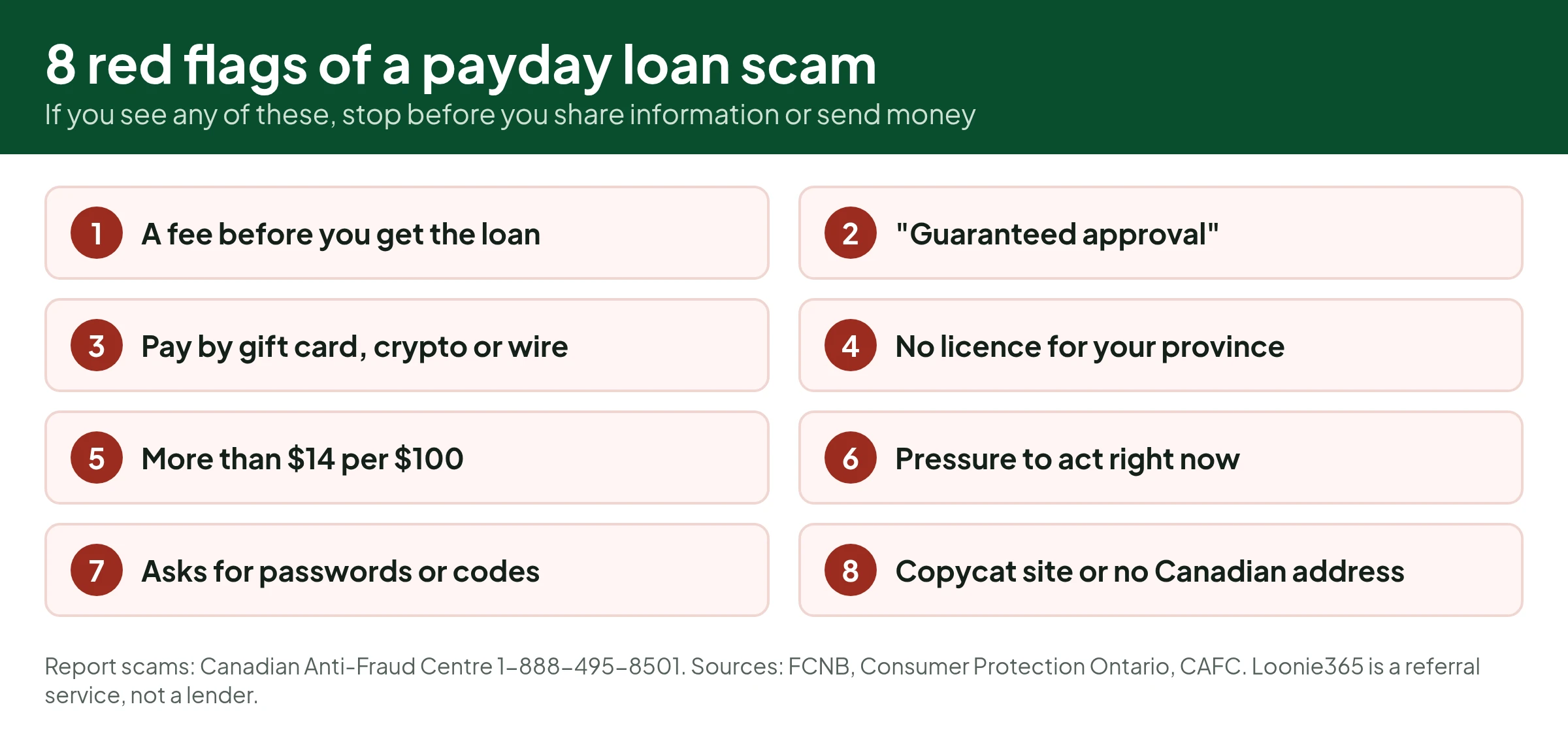
An upfront fee
“Processing”, “insurance”, “first payment” or “security deposit” due before you get the money. Licensed payday lenders take their fee when the loan is repaid.
Guaranteed approval
Real lenders must check your income; in many provinces they’re legally limited to a share of your net pay. “Guaranteed, even with bad credit” is a warning sign.
Unusual payment methods
Gift cards, prepaid cards, crypto, wire transfers or an e-Transfer to a person’s email.
No provincial licence
No licence number, a licence from another province only, or a number that doesn’t match the regulator’s list.
Costs above the legal limit
More than $14 per $100 in a province with payday loan laws, or any “payday loan” offered to someone in Quebec or the territories at payday rates.
Pressure to act now
“Offer expires in 10 minutes” or repeated calls and texts you didn’t ask for.
Requests for passwords or codes
Your online banking password, a one-time code or remote access to your phone or computer. Bank-verification tools never need you to send codes to a person.
A copycat website
A name or logo that mimics a real lender, but a different web address, no physical address in Canada, or only a mobile number and an email.
Common payday loan scams in Canada
| Scam | How it works | What to do |
|---|---|---|
| Advance-fee loan | A fake lender “approves” you instantly, then asks for a fee before sending the loan. The loan never arrives. | Never pay. Report to the CAFC. |
| Fake lender website | A copy of a real lender’s site collects your ID and banking details for identity theft. | Type the lender’s address yourself and check its licence. |
| Data resale | A site that looks like a lender is really collecting applications to sell, sometimes to unlicensed lenders. | Read who receives your information before applying. |
| Fake debt collector | Calls or emails demand payment for a “payday loan” you don’t recognize, threatening arrest or wage garnishment. | Ask for written details and verify. See wage garnishment threat emails. |
| Overpayment or “test” deposit | A “lender” sends money, claims it sent too much, and asks you to send the difference back. | Don’t send money back; call your bank. |
Courts, not lenders, order wage garnishment, and only after a lawsuit and judgment. No one can be arrested for an unpaid payday loan.
How to check a payday lender’s licence in your province
| Province or territory | Who licenses payday lenders | Phone |
|---|---|---|
| Alberta | Service Alberta | 1-877-427-4088 |
| British Columbia | Consumer Protection BC | 1-888-564-9963 |
| Manitoba | Consumer Protection Office | 1-800-782-0067 |
| New Brunswick | FCNB | 1-866-933-2222 |
| Newfoundland and Labrador | Consumer and Financial Services Division | 1-877-968-2600 |
| Nova Scotia | Service Nova Scotia | 1-800-670-4357 |
| Ontario | Consumer Protection Ontario | 1-800-889-9768 |
| Prince Edward Island | Financial and Consumer Services Division | 1-800-658-1799 |
| Saskatchewan | FCAA Consumer Credit Division | 306-787-6700 |
| Quebec | Office de la protection du consommateur (permits) | 1-888-672-2556 |
| Nunavut | Consumer Affairs | 1-866-223-8139 |
Yukon and the Northwest Territories: use the federal directory of consumer affairs offices.
What a legitimate payday lender looks like
Signs it’s legitimate
- A provincial licence number you can verify
- The total cost in dollars and as an annual rate, before you sign
- A written agreement with your right to cancel
- Fees collected only when the loan is due
- A real Canadian business address and phone number
Signs to walk away
- Any payment before you get the money
- “Guaranteed” or “no questions asked” approval
- Gift card, crypto or wire payments
- A cost above $14 per $100
- Requests for your banking password or one-time codes
Loonie365 is a referral service, not a lender, and never asks for a fee. See our disclosure and editorial policy. If you’re comparing costs, use the payday loan calculator.
If you’ve been scammed
Stop paying
Don’t send more money, even if they promise the loan after “one last fee”.
Call your bank
Ask it to stop or recall payments, and change your online banking password if you shared it.
Report it
Canadian Anti-Fraud Centre: 1-888-495-8501 or reportcyberandfraud.canada.ca. Also report to local police.
Protect your credit
If you shared ID, contact Equifax and TransUnion about a fraud alert, and watch your credit report.
Payday loan scam FAQ
Do legitimate payday lenders charge an upfront fee?
No. Licensed payday lenders collect their fee when the loan is repaid. Provinces such as PEI and Nova Scotia bar lenders from deducting the cost of borrowing from the advance. Any request to pay before you get the loan is a red flag.
How can I tell if an online payday lender is real?
Check that it shows a licence number for your province and that the number matches the provincial regulator’s list. Online lenders need the same licence as stores.
Are guaranteed payday loans real?
No. Licensed lenders must check your income, and many provinces limit a loan to a share of your net pay. Guaranteed approval is one of the signs of a loan scam listed by FCNB.
Can I be arrested for not paying a payday loan?
No. An unpaid payday loan is a civil debt. A lender or collection agency can sue you, and a court can order garnishment after a judgment, but threats of arrest are a scam tactic.
Where do I report a payday loan scam in Canada?
To the Canadian Anti-Fraud Centre at 1-888-495-8501 or reportcyberandfraud.canada.ca, to your local police, and to your provincial consumer protection office.
I sent money to a fake lender. Can I get it back?
Call your bank or card issuer immediately; some payments can be stopped or disputed if you act quickly. Report the scam to the Canadian Anti-Fraud Centre and police, and don’t pay anyone who offers to recover your money for a fee.
Borrow safely
If you need a short-term loan, start with the cheapest options, and only borrow from a lender licensed in your province.
Loonie365 is a referral service, not a lender, and never charges borrowers. Approval is never guaranteed.